

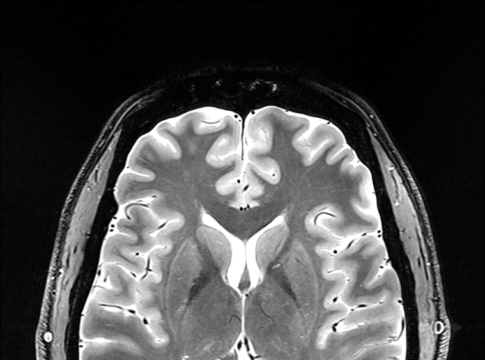
The subjective experience of self-awareness is attributed to the human capacity for introspective thought during periods of mind-wandering. However, how this cognitive function is impacted in individuals with mild cognitive impairment (MCI) still needs to be better understood. To address this gap, we investigated alterations in self-referential thinking in a cohort of 30 MCI patients, comparing them to 60 healthy old-aged and 60 healthy younger controls. MCI patients exhibited a notable decline in overall cognitive function, as evidenced by significantly lower scores on the Montreal Cognitive Assessment (MoCA), with particular deficits in Memory subscore and Memory Index Score (MIS). Employing the Amsterdam Resting-State Questionnaire (ARSQ) to assess mind-wandering, we observed diminished self-related thoughts relating to personal past experiences and future thinking among MCI patients. Notably, using high-density electroencephalography (hdEEG) microstate analysis, we detected reduced neural activity for microstate C associated with self-related thoughts in MCI patients and healthy older relative to healthy younger controls, and an increase in neural activity for microstate A in MCI patients compared to healthy older and younger controls. This aberrant temporal activity was localized within brain regions implicated in episodic autobiographical memory and the default mode network. Our results highlight a link between impaired mind-wandering ability and dysfunction within the intrinsic neural networks of MCI patients, underscoring its implications for disruptions in the sense of self within this clinical population.
Publication scientifique
Self-related thought alterations associated with intrinsic brain dysfunction in mild cognitive impairment
Autres publications de la plateforme
Motor-evoked modules obtained from transcranial magnetic stimulation
Morishita, Takuya; Coscia, Martina; Bacigalupo, Mirea; Lassi, Michael; Proulx, Camille E.; Fleury, Lisa; Hummel, Friedhelm C.
Journal of Neurophysiology
Characterising the Diffusion Functional Signature of Negative BOLD With Interleaved TMS...
De Riedmatten, Inès; Spencer, Arthur P. C.; Martuzzi, Roberto; Rochas, Vincent; Pérot, Jean‐Baptiste; Szczepankiewicz, Filip; Jelescu, Ileana O.
Human Brain Mapping
Real-time reinforcement for human-machine interface control
Vassiliadis, Pierre; Pinheiro, Daniel Leal; Fleury, Lisa; Zenon, Alexandre; Esparza-Iaizzo, Martín; Ingster, Abigaïl; Micera, Silvestro; Shokur, Solaiman; Hummel, Friedhelm C.
Neuron
EEG microstates: from methodological foundations to clinical translation
Michel, Christoph M.; Bréchet, Lucie
Trends in Neurosciences
Linguistic pitch is hierarchically encoded in the right ventral stream
Oderbolz, Chantal; Orpella, Joan; Meyer, Martin
Communications Biology
Causal disconnectomics of motion perception networks: insights from transcranial magnetic stimulation‐induced...
Raffin, Estelle; Salamanca‐Giron, Roberto F.; Huxlin, Krystel R.; Reynaud, Olivier; Mattera, Loan; Martuzzi, Roberto; Hummel, Friedhelm C.
The Journal of Physiology
Journal de publication
Scientific Reports
Auteurs:
Tarailis, Povilas; Lory, Kim; Unschuld, Paul G.; Michel, Christoph M.; Bréchet, Lucie
Date de publication:
Plateforme:
Études récentes de la plateforme
Perte de conscience de soi
Eveiller la prise de conscience
Les troubles de la conscience de soi ne sont pas tous immédiatement perceptibles : certains restent masqués lors d'un...
Quand le cerveau s’éteint à l’IRM : un signal plus complexe...
Quand une diminution du signal reste difficile à interpréter
L’imagerie par résonance magnétique fonctionnelle (IRMf) permet de repérer les régions du cerveau qui réagissent...
La connaissance comme récompense
Comparaison de différents types de récompenses
Les participants prennent part à une tâche comprenant trois types de récompenses, de valeur élevée ou faible :
-...