


Rhythmic cerebral activity predicts whether the visual or the auditory component of speech influences perception. , When we see our interlocutor, our brain seamlessly extracts visual cues from their face and processes them along with the sound of their voice, making speech an intrinsically multimodal signal. Visual cues are especially important in noisy environments, when the auditory signal is less reliable. Neuronal oscillations might be involved in the cortical processing of audiovisual speech by selecting which sensory channel contributes more to perception. To test this, we designed computer-generated naturalistic audiovisual speech stimuli where one mismatched phoneme-viseme pair in a key word of sentences created bistable perception. Neurophysiological recordings (high-density scalp and intracranial electroencephalography) revealed that the precise phase angle of theta-band oscillations in posterior temporal and occipital cortex of the right hemisphere was crucial to select whether the auditory or the visual speech cue drove perception. We demonstrate that the phase of cortical oscillations acts as an instrument for sensory selection in audiovisual speech processing.
Publication scientifique
The phase of cortical oscillations determines the perceptual fate of visual cues in naturalistic audiovisual speech
Autres publications de la plateforme
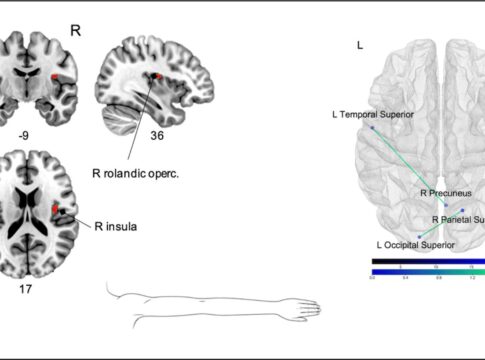
Motor-evoked modules obtained from transcranial magnetic stimulation
Morishita, Takuya; Coscia, Martina; Bacigalupo, Mirea; Lassi, Michael; Proulx, Camille E.; Fleury, Lisa; Hummel, Friedhelm C.
Journal of Neurophysiology
Characterising the Diffusion Functional Signature of Negative BOLD With Interleaved TMS...
De Riedmatten, Inès; Spencer, Arthur P. C.; Martuzzi, Roberto; Rochas, Vincent; Pérot, Jean‐Baptiste; Szczepankiewicz, Filip; Jelescu, Ileana O.
Human Brain Mapping
Real-time reinforcement for human-machine interface control
Vassiliadis, Pierre; Pinheiro, Daniel Leal; Fleury, Lisa; Zenon, Alexandre; Esparza-Iaizzo, Martín; Ingster, Abigaïl; Micera, Silvestro; Shokur, Solaiman; Hummel, Friedhelm C.
Neuron
EEG microstates: from methodological foundations to clinical translation
Michel, Christoph M.; Bréchet, Lucie
Trends in Neurosciences
Linguistic pitch is hierarchically encoded in the right ventral stream
Oderbolz, Chantal; Orpella, Joan; Meyer, Martin
Communications Biology
Causal disconnectomics of motion perception networks: insights from transcranial magnetic stimulation‐induced...
Raffin, Estelle; Salamanca‐Giron, Roberto F.; Huxlin, Krystel R.; Reynaud, Olivier; Mattera, Loan; Martuzzi, Roberto; Hummel, Friedhelm C.
The Journal of Physiology
Journal de publication
Science Advances
Auteurs:
Thézé, Raphaël; Giraud, Anne-Lise; Mégevand, Pierre
Date de publication:
Plateforme:
Études récentes de la plateforme
Perte de conscience de soi
Eveiller la prise de conscience
Les troubles de la conscience de soi ne sont pas tous immédiatement perceptibles : certains restent masqués lors d'un...
Quand le cerveau s’éteint à l’IRM : un signal plus complexe...
Quand une diminution du signal reste difficile à interpréter
L’imagerie par résonance magnétique fonctionnelle (IRMf) permet de repérer les régions du cerveau qui réagissent...
La connaissance comme récompense
Comparaison de différents types de récompenses
Les participants prennent part à une tâche comprenant trois types de récompenses, de valeur élevée ou faible :
-...